

Description
GHS Pictograms & Hazard Communication Poster
Help employees recognize chemical hazards and understand OSHA's Hazard Communication requirements with the GHS Pictograms & Hazard Communication Poster. This 18 x 24-inch workplace safety poster provides a visual reference for the standardized pictograms and hazard communication information used to identify chemical hazards in the workplace.
The Globally Harmonized System of Classification and Labelling of Chemicals (GHS) provides a standardized approach for classifying chemical hazards and communicating those hazards through labels, pictograms, signal words, hazard statements, precautionary statements, and Safety Data Sheets (SDSs).
What Is GHS?
GHS stands for Globally Harmonized System of Classification and Labelling of Chemicals. OSHA incorporates GHS elements into its Hazard Communication Standard to provide a more consistent method for classifying hazardous chemicals and communicating chemical hazards to workers.
Under OSHA's Hazard Communication Standard, employers with hazardous chemicals in the workplace may have responsibilities involving a written hazard communication program, chemical labels and warnings, Safety Data Sheets, and employee information and training.
What Are GHS Pictograms?
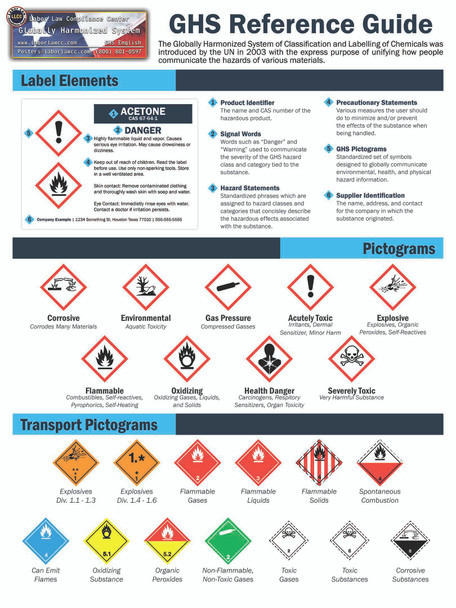
GHS pictograms are standardized graphic symbols used on hazardous chemical labels to communicate specific types of physical and health hazards. OSHA-required pictograms use a black hazard symbol on a white background surrounded by a red diamond-shaped border.
Depending on the chemical and its hazard classification, employees may encounter pictograms representing hazards such as:
- Flammability
- Oxidizing hazards
- Acute toxicity
- Corrosive hazards
- Explosive or reactive hazards
- Serious health hazards
- Irritation and other less severe health effects
- Gases under pressure
What Information Appears on a GHS Chemical Label?
OSHA's Hazard Communication Standard requires specified information on shipped containers of classified hazardous chemicals. Depending on the hazard classification, label elements can include:
- Product Identifier – identifies the hazardous chemical
- Signal Word – uses "Danger" or "Warning" to indicate the relative severity of a hazard
- Hazard Statement – describes the nature and, where appropriate, degree of the chemical hazard
- Pictogram – provides a visual symbol representing a particular type of hazard
- Precautionary Statement – describes recommended measures for preventing or minimizing harmful effects from exposure, handling, or storage
- Supplier Information – identifies the chemical manufacturer, importer, or other responsible party as required
What Is a Safety Data Sheet (SDS)?
A Safety Data Sheet (SDS) provides standardized information about a hazardous chemical, including its hazards, composition, safe handling and storage, exposure controls, first-aid measures, emergency procedures, and other important safety information.
OSHA requires chemical manufacturers and importers to prepare an SDS for hazardous chemicals they produce or import, and employers must maintain Safety Data Sheets for hazardous chemicals used in the workplace as required by the Hazard Communication Standard.
SDS vs. MSDS: What Changed?
The standardized Safety Data Sheet (SDS) format replaced the older Material Safety Data Sheet (MSDS) format under OSHA's revised Hazard Communication Standard. The standardized SDS format organizes chemical safety information into 16 sections so employees and employers can more consistently locate important hazard information.
GHS itself did not simply "replace the MSDS." Instead, OSHA aligned its Hazard Communication Standard with elements of GHS, including standardized hazard classification, label elements, pictograms, and the standardized Safety Data Sheet format.
What Are the 16 Sections of a Safety Data Sheet?
The standardized SDS format includes the following sections:
- Identification
- Hazard(s) Identification
- Composition/Information on Ingredients
- First-Aid Measures
- Fire-Fighting Measures
- Accidental Release Measures
- Handling and Storage
- Exposure Controls/Personal Protection
- Physical and Chemical Properties
- Stability and Reactivity
- Toxicological Information
- Ecological Information
- Disposal Considerations
- Transport Information
- Regulatory Information
- Other Information
OSHA Hazard Communication Training
Under 29 CFR 1910.1200, employers covered by the Hazard Communication Standard must provide employees with effective information and training about hazardous chemicals in their work areas. Training must address applicable chemical hazards, protective measures, workplace labeling systems, Safety Data Sheets, and how employees can obtain and use hazard information.
A GHS pictogram poster can provide employees with a convenient visual reference and help reinforce an employer's established Hazard Communication training program.
Where Can a GHS Pictograms Poster Be Displayed?
The GHS Pictograms & Hazard Communication Poster can help reinforce chemical safety awareness in workplaces such as:
- Manufacturing facilities
- Warehouses and distribution centers
- Laboratories
- Maintenance departments
- Automotive and repair facilities
- Industrial workplaces
- Cleaning and janitorial operations
- Healthcare facilities
- Construction operations
- Chemical storage and handling areas
- Employee safety and training areas
Is a GHS Pictograms Poster Required by OSHA?
OSHA's Hazard Communication Standard requires covered employers to comply with applicable requirements for chemical hazard communication, which can include labels and other warnings, Safety Data Sheets, employee information and training, and a written Hazard Communication program.
This particular GHS Pictograms & Hazard Communication Poster is intended as a supplemental employee training and chemical safety awareness resource. It should not be represented as a universally required OSHA workplace poster and does not replace required employee training, chemical labeling, Safety Data Sheets, or an employer's written Hazard Communication program.
GHS Pictograms Poster Specifications
- 18"W x 24"H
- Portrait orientation
- Printed in full color
- Laminated with high-quality laminate
- Available in English and Spanish
Workplace Safety and Compliance Resources
Labor Law Compliance Center provides employers with labor law posters, workplace safety posters, specialty postings, and compliance resources for businesses throughout the United States. Explore our additional workplace safety and compliance materials to help reinforce employee training, hazard awareness, and workplace safety procedures.